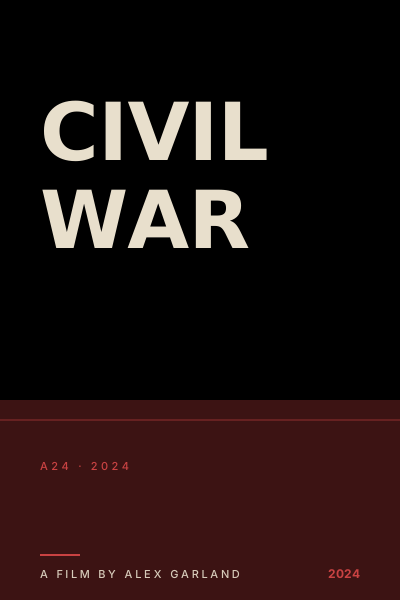
Alex Garland's Civil War is the rare American political film that refuses to take sides politically. The film follows four war photographers driving from New York to Washington through a United States in armed conflict. Who is fighting whom, and why, is deliberately unclear. The film is not interested in politics. It is interested in what it does to the people who cover it.
Kirsten Dunst is the film's anchor, playing Lee, a veteran photojournalist who has seen this type of conflict before and who has developed the protective professional numbness that the job requires. Cailee Spaeny plays Jessie, a young photographer who has not yet learned how to stop feeling. Wagner Moura and Stephen McKinley Henderson complete the four-person road trip. Jesse Plemons shows up for one scene that will be talked about for years.
Quiet Dread
What is most remarkable about Civil War is how restrained it is. Garland, who made Ex Machina and Annihilation, is capable of spectacle. He deploys it sparingly. The violence, when it arrives, is sudden, muffled, and unglamorous. The loudest moments are the silence after. Rob Hardy's cinematography is composed, grave, and rarely pretty.
The Plemons scene — a traffic stop, essentially — is the year's most unnerving dramatic sequence. It is eight minutes long and I will not say anything else about it.
Controversy and Restraint
Civil War was criticized at release for refusing to identify political villains. I think this criticism misses the point. Garland is not making a film about how one political party is right and the other is wrong. He is making a film about what happens when a country breaks. In that register, the film is remarkably clear-eyed.
Playing in IMAX and Dolby at Scotiabank Theatre Toronto, Scotiabank Theatre Vancouver, Cineplex Varsity, and Landmark Country Hills Calgary.